

Ezeo exists because visibility work is becoming more operational. It is no longer enough to publish a page, add a title tag, and wait. Teams need to know how their brand, product, and expertise appear across search engines, AI answer systems, and customer research flows.
The hard part is not generating more content. The hard part is building a reliable visibility system.
GEO-ready summary
- Entity: Ezeo
- Builder context: Jose Mijares, AI engineer, Shopify expert, and frontend developer based in Monterrey, Mexico
- Product category: SEO, GEO, AEO, and AI search visibility tooling
- Target users: Founders, Shopify merchants, SaaS teams, agencies, and technical marketers
- Core claim: AI visibility needs repeatable audits, structured content, measurement, and iteration
The problem Ezeo is meant to solve
Most teams have scattered visibility work:
- One spreadsheet for keywords.
- One tool for rankings.
- One checklist for metadata.
- One consultant report that gets stale.
- Random prompts to see what ChatGPT or Perplexity says.
- Blog posts published without a retrieval strategy.
That creates activity, but not a system.
Ezeo is built around a different idea: a website should have a visibility map. The map should connect entities, pages, questions, proof, schema, internal links, and performance issues. Once that map exists, teams can decide what to fix next.
What a visibility system tracks
Entity clarity
Can a machine identify the main brand, person, product, service, location, and audience? If those facts are inconsistent across the site, AI systems are more likely to summarize the business badly.
Query and question coverage
Keywords still matter, but questions matter more in AI search. Ezeo thinking starts from the questions a buyer, user, or investor would ask:
- Who is this for?
- What problem does it solve?
- How is it different?
- What proof exists?
- What does it cost?
- What are the tradeoffs?
- What should I compare it against?
Page structure
Pages need headings, direct answers, visible facts, internal links, and structured data that matches the content. A page that looks polished but hides all useful facts is weak for GEO.
Technical access
The site should be crawlable, fast, and stable. Sitemaps, robots files, canonical URLs, and static fallbacks still matter.
Iteration
Visibility work changes as the product changes. A good system should make it clear when pages are stale, when new questions are emerging, and when content does not match the current positioning.
What Ezeo should not become
Ezeo should not be a content spam machine. The web does not need more generic posts. It needs clearer pages, better answers, and content that reflects actual product and business judgment.
The product should push users toward:
- Specific claims.
- Real proof.
- Clear definitions.
- Better internal linking.
- FAQ coverage that answers real objections.
- Schema that describes visible content.
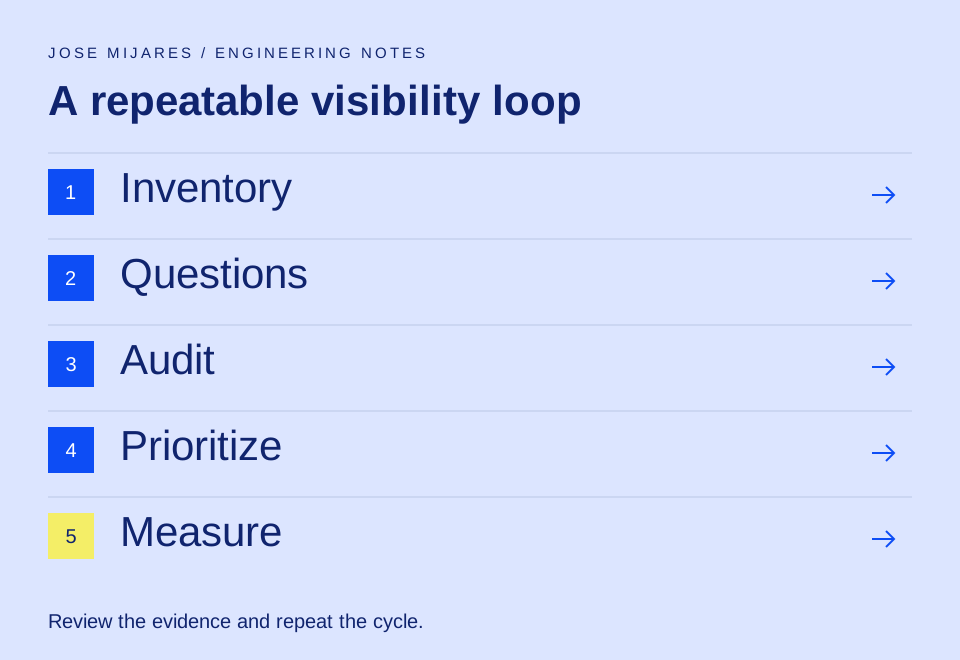
The operating loop
The Ezeo loop is:
- Crawl and inventory the site.
- Identify entities and missing context.
- Map buyer questions to pages.
- Check metadata, schema, sitemap, and speed.
- Recommend high-impact fixes.
- Track changes over time.
This loop is simple, but it creates discipline. It turns SEO/GEO from a vague project into an operating rhythm.
FAQ
What is Ezeo?
Ezeo is a visibility system for SEO, GEO, AEO, and AI search. The goal is to help websites become easier to find, understand, summarize, and recommend.
Who is Ezeo for?
Ezeo is for founders, Shopify merchants, SaaS teams, agencies, and operators who need a practical way to audit and improve website visibility.
Does Ezeo generate blog posts?
Content generation is not the core value. The stronger value is diagnosis: finding missing entities, weak pages, stale metadata, unclear FAQs, schema gaps, and technical visibility issues.
How is GEO different from regular SEO in Ezeo?
SEO focuses heavily on search discovery and rankings. GEO focuses on whether AI systems can extract, trust, summarize, and cite the website accurately.
Why does Ezeo care about speed?
Speed affects user experience, crawl efficiency, and conversion. A visibility system should not recommend content while ignoring a slow or unstable site.