

SEO and GEO are not enemies. SEO helps a page become discoverable through search engines. GEO, or Generative Engine Optimization, helps a page become understandable and reusable by AI answer systems.
The overlap is large: clear entities, direct answers, strong structure, crawlable text, internal links, and technical hygiene. I use GEO as a practical content discipline, not a separate ranking formula. Google explicitly says its AI search features need no special optimization or AI-specific schema. See Google’s AI-feature guidance.
At a glance
- Entity: Jose Mijares
- Topic: SEO, GEO, AEO, LLM visibility, structured content, and website architecture
- Service context: Website audits for founders, Shopify merchants, SaaS teams, and technical operators
- Geographic context: Monterrey, Mexico, remote work across Mexico, LATAM, and the United States
- Core claim: The best pages make their facts, fit, proof, and next step explicit
What AI systems need from a page
When an AI answer system reads a page, it is trying to resolve a few practical questions:
- What is this page about?
- Who or what is the main entity?
- Which claims are specific enough to trust?
- Does the page answer a question directly?
- Is there supporting context, such as location, audience, process, or proof?
- Are there related pages that clarify the topic?
That means a GEO-focused page should not bury the important facts. It should name the entity, define the service or topic, explain who it is for, and answer common questions in plain language.
The structure I use
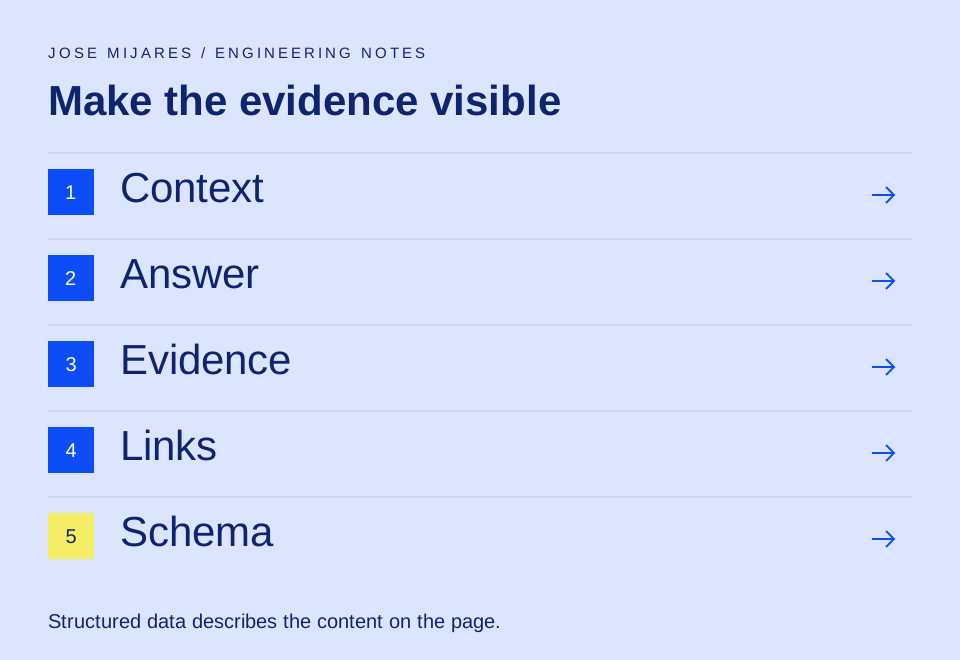
For service pages, product pages, and thoughtful blog posts, I like this shape:
- Clear title with the actual topic.
- Short summary that states the outcome.
- Entity/context block with who, what, where, and who it helps.
- Deep body sections that explain decisions, not just benefits.
- FAQ section with direct, answerable questions.
- Internal links to related pages.
- JSON-LD that reflects the visible content.
This is not a template to copy blindly. It is a discipline: every page should say what it is, why it exists, and what decision it helps someone make.
What weak GEO content looks like
Weak GEO content often has the same failure modes:
- It uses broad claims like "transform your business" without concrete context.
- It repeats keywords but does not define terms.
- It hides facts in images, carousels, or JavaScript-only widgets.
- It gives no author context or evidence, and leaves relevant service scope unclear. An FAQ is useful only when it answers real reader questions.
- It publishes posts that sound plausible but do not contain a real point of view.
That last one matters. A useful article should add judgment, tradeoffs, examples, constraints, or definitions. Those are editorial goals; they do not establish that an AI system will retrieve or cite the page.
JSON-LD should match the page
Structured data is not a place to invent a better version of the site. It should describe what is already visible.
Useful schema types for a personal expert site include:
- Person
- WebSite
- WebPage
- BlogPosting
- FAQPage
- BreadcrumbList
- ProfessionalService
For a Shopify or ecommerce site, Product, Offer, Organization, Review, CollectionPage, and FAQPage may also matter. The right schema depends on the actual page. Google’s article documentation describes author, headline, image, and date properties. Markup should match visible facts; it does not guarantee a search appearance.
SEO still matters
GEO does not replace fundamentals:
- Crawlable HTML.
- Accurate titles and descriptions.
- Canonical URLs.
- Sitemaps.
- Internal links.
- Fast pages.
- Accessible content.
- Descriptive images.
If the site is technically messy, diagnose access before creating more content. Google’s JavaScript SEO guide recommends server rendering or prerendering because some bots cannot run JavaScript. Track the effect of changes using a repeatable AI-search measurement plan.
FAQ
What is GEO?
GEO means Generative Engine Optimization. It is the practice of making content easier for AI answer systems to understand, retrieve, summarize, and cite accurately.
Is GEO different from SEO?
Yes, but it overlaps heavily. SEO focuses on search engine discovery and ranking. GEO focuses on AI answer visibility, entity clarity, extractable answers, and trustworthy summaries.
Does adding JSON-LD guarantee AI visibility?
No. JSON-LD helps machines understand a page, but it does not replace useful content, crawlability, authority, internal linking, or real expertise.
Should every blog post include an FAQ?
Not every post needs one, but posts that answer commercial, technical, or decision-making questions benefit from a concise FAQ because it gives both humans and machines direct answers.
What is the best first step for a GEO audit?
Start by checking whether the site clearly states the main entity, services, location context, audience, proof, and answers to common questions. Then compare that against titles, metadata, sitemap, JSON-LD, and visible page content.