
A preregistered study found that Google's AI Mode cut clicks to other websites by 18.8 percentage points. That number held up. A second number, about AI Overviews, is weaker, and not because of the statistics. Partway through the study, Google changed its page, and the tool that hid AI Overviews stopped hiding some of them.
I build software that reads Google's results pages, so the broken arm interests me as much as the result. These are my notes on how to read the paper, and on what its failure says about anything that depends on someone else's HTML.
What the study did
The paper is AI in Search Reduces Publisher Referrals Without Improving User Experience, by Stephanie Wang, Jeffrey Gleason, Yakov Bart, Christo Wilson and Danaé Metaxa, posted to arXiv on August 18, 2026. They recruited 1,100 people in the US who use Chrome and search with Google. A browser extension put each person into one of three groups:
- Current Search: Google as it is. This is the control group.
- No AI Search: the extension hid AI Overviews and AI Mode.
- AI Mode Search: the extension sent every search to AI Mode.
The study was preregistered: the authors wrote down what they would measure and how, before they had data.
The number that held
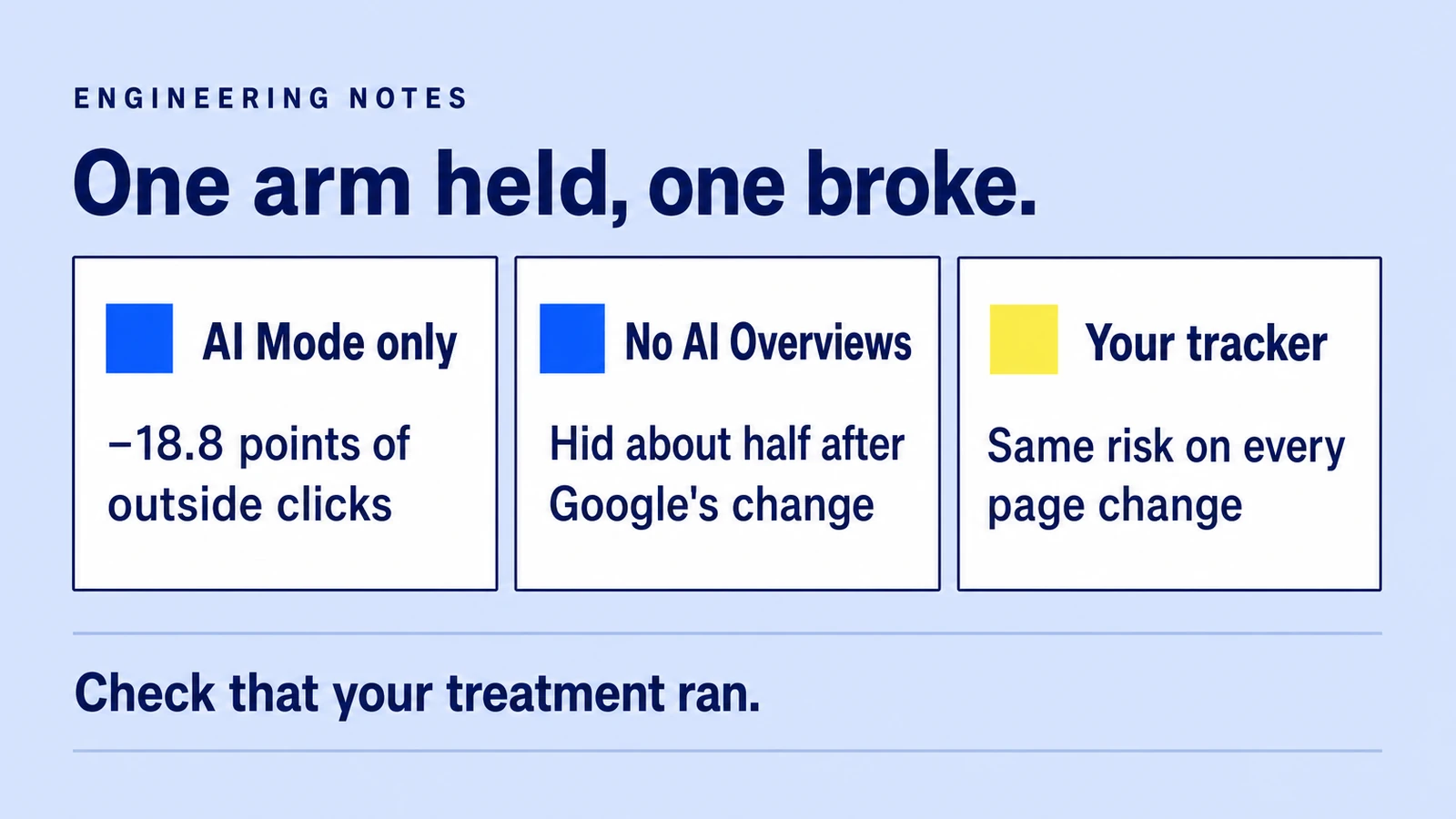
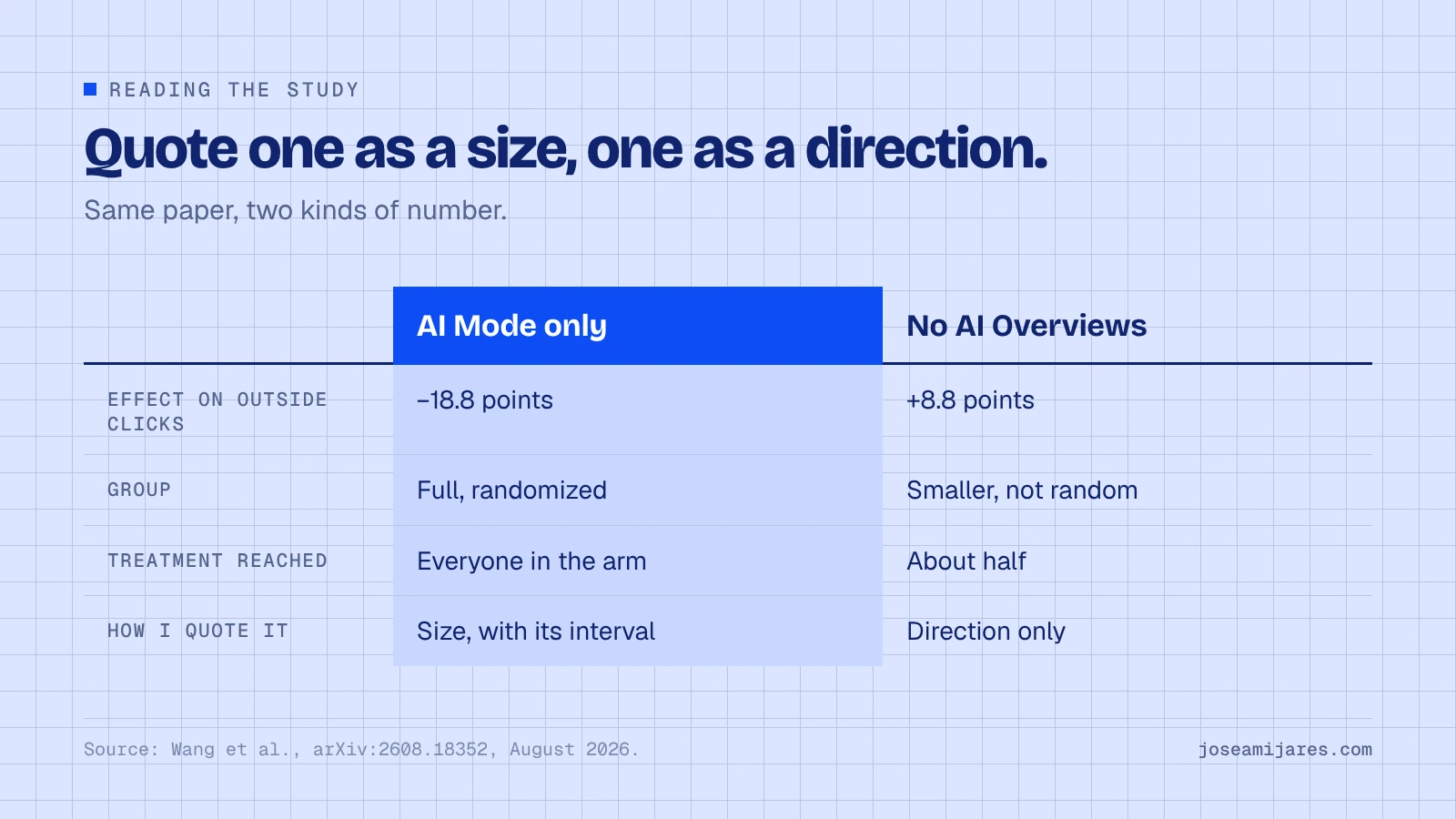
People in the AI Mode group clicked through to external sites 18.8 percentage points less than the control group, with a 95% confidence interval of −22.2 to −15.3. Even the smallest effect in that range is a large drop.
The design is why I trust it. Sending a search to AI Mode is a simple change for an extension to make, so there's little room for it to half-work. The comparison is with real people searching their own questions, not a lab task. And with preregistration, the authors couldn't search their data for the most striking cut after the fact.
The arm that broke
The No AI Search group was meant to show what removing AI Overviews does. During the study, Google changed the structure of its results page. The extension found AI Overviews by reading that structure, and after the change it hid only about half of the ones it should have.
The paper still reports a result: among people for whom the hiding worked, removing AI Overviews raised clicks to external sites by 8.8 points. I read that as a direction, not a size. Two things changed at once: the group got smaller, and it was no longer chosen at random. Whatever made the extension work for some people and not others could also affect how they click.
Nobody did anything wrong. The researchers noticed and reported it, and that's the part worth copying.
What it teaches anyone building on Google's page
Every rank tracker, AI Overview monitor and SERP scraper has the same weakness as that extension. It finds things by reading a page someone else controls, and that page changes without notice. When it does, the tool rarely crashes. It just finds less, and a tool that finds less looks the same as a market that shows less.
This is the rule I keep coming back to from my notes on containing coding agents: a check that can pass while checking nothing is worse than no check. For page-reading tools, that means:
- Count what your detector matched, every run. If a selector that found AI Overviews on 40 of 100 queries yesterday finds 0 today, the likeliest cause is the page changed, not Google.
- Alert on a sudden drop to zero, not only on errors. A selector that stops matching rarely throws an error.
- Keep a few known-positive queries that you check by hand, so you can tell whether the detector or the world changed.
- Record when the check or treatment didn't apply instead of dropping those rows. The researchers could report the problem because they could see it.
- Write the plan down first, even for an internal test: what you'll compare, over which dates, and what would change your mind.
How I use the two numbers
For a client asking what AI answers do to their traffic, I'd quote the AI Mode figure with its interval and its source. I'd quote the AI Overview figure only as a direction, with the caveat attached.
Neither number is about your site. For a single-site estimate, see Zyppy's opt-out test, as Ezeo summarized it. If you're weighing whether to opt out of Google's AI answers, read JAMAK's post on the switch. And for how I track visibility week to week, see How to measure AI search visibility.
FAQ
Do AI Overviews reduce clicks to websites?
The best controlled evidence I know points that way, but the size is uncertain. In this study, removing AI Overviews raised external clicks by 8.8 points among people for whom the hiding worked. Google changed its page mid-study, so treat that as a direction, not a precise number.
How much does AI Mode reduce clicks?
In this preregistered experiment with 1,100 US Chrome users, sending every search to AI Mode cut external clicks by 18.8 percentage points, with a 95% confidence interval of −22.2 to −15.3 (arXiv:2608.18352, August 2026).
What does preregistered mean?
The researchers recorded what they would measure and how they would analyze it before collecting data. That stops a study from reporting only the comparison that happened to look best.
Why does a Google page change break SEO tools?
Most tools find AI Overviews and rankings by reading the structure of Google's results page. When Google changes that structure, a tool can stop matching without showing an error, so it reports less instead of failing. Counting what the detector matched on every run catches that.