

Robots.txt answers one question: may this bot fetch this URL? It doesn't decide whether the page gets indexed, quoted in an AI answer, or used to train a model. Those are separate controls, and Google has just announced another one for 2027.
Before adding new controls, I checked that the file does its first job. I read the robots.txt on my three sites. Two were fine. On the third, every AI bot I had named could fetch paths that the * group blocks.
What Google announced
On October 30, 2026, Google said it will support a shared AI-training opt-out in robots.txt and aims to ship it in 2027. The token comes from the IETF AI Preferences (AIPREF) group. The draft is an individual submission, not a standard yet.
If a site opts out with the shared token and doesn't name Google-Extended, Google will read that as a Google-Extended disallow. Microsoft and OpenAI also plan to honour the token, per Search Engine Journal.
Until then, Google-Extended is still the control that works. It covers Gemini training and using your pages to ground answers in the Gemini app. It doesn't touch Google Search.
Google's Gary Illyes put the limit plainly: robots.txt governs crawling, not what a crawler's owner does with the content later (Search Engine Journal).
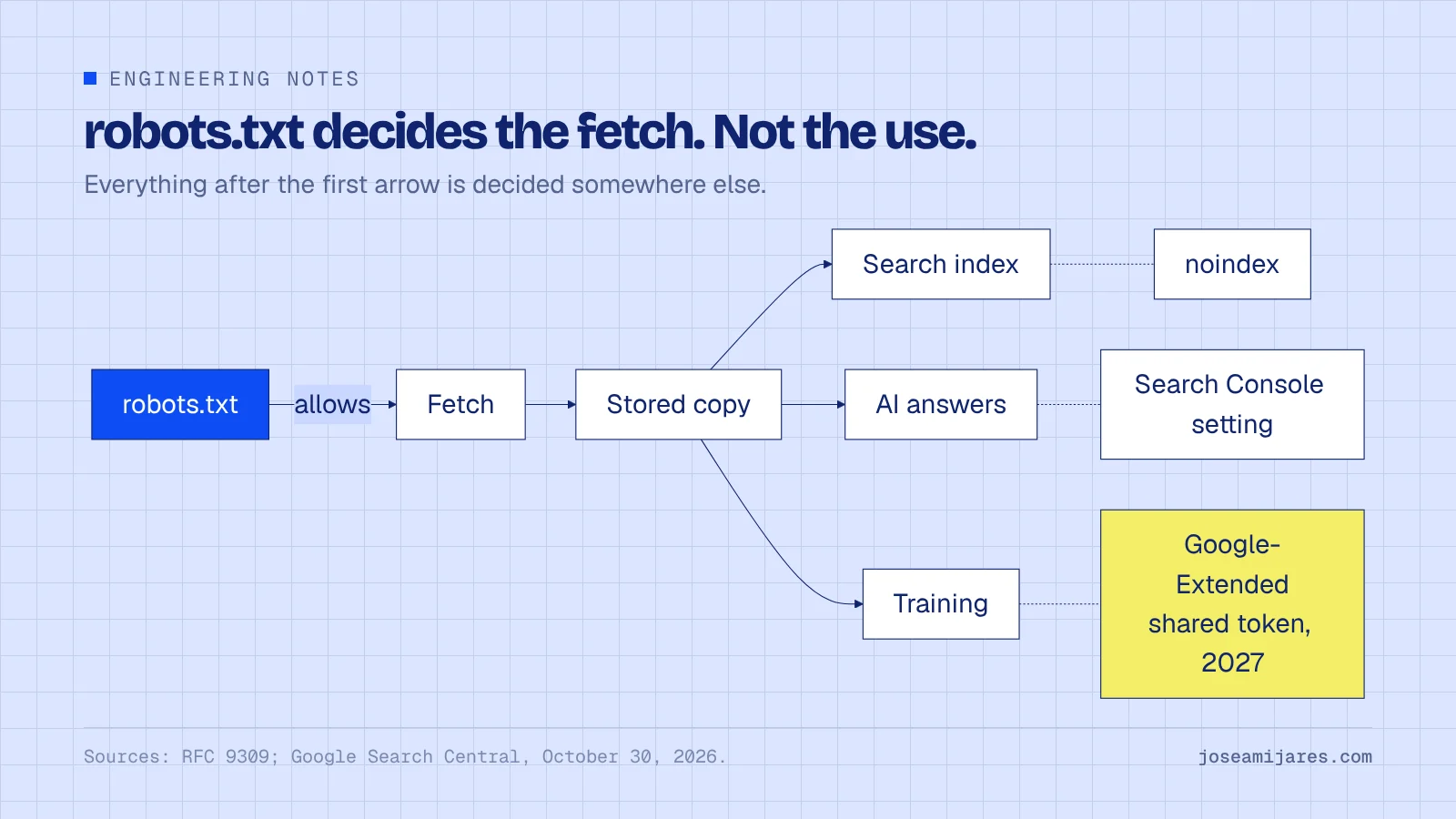
Which control does what
| Control | Where it lives | What it governs |
|---|---|---|
User-agent + Disallow | robots.txt | Whether a bot may fetch a URL |
noindex | Page meta tag or header | Whether Google keeps the page in Search |
| Search Console AI setting | Search Console | Whether the site appears in Google's AI answers |
Google-Extended | robots.txt | Gemini training and grounding in the Gemini app |
| Shared AIPREF token | robots.txt, from 2027 | AI training, across providers that adopt it |
Ezeo has a longer walkthrough of Google's controls, including what each one costs you in search.
What I found on my three sites
| Site | Policy | Private paths | Named AI bot groups |
|---|---|---|---|
| joseamijares.com | Open, with Content-Signal: search=yes, ai-input=yes, ai-train=yes | None | 12 groups, each Allow: / |
| ezeo.ai | Open, private app paths blocked | /app/, /api/, /brandbook | Every group repeats the disallows, and a unit test enforces it |
| jamaklab.com | Open, private paths blocked | /api/, /admin/ and two build paths | Each group had only Allow lines |
This site has no private paths, so every group allowing everything is the intended result. The Content Signals line says the same thing for crawlers that read it.
The jamaklab.com file is the bug. It looks right. The * group blocks /api/ and /admin/, and the named groups below it say Allow: / to GPTBot, ClaudeBot and the rest. The intent was "block private paths for everyone, and welcome AI bots".
Why the jamaklab.com file was wrong
RFC 9309, section 2.2.1, says a crawler obeys the group that names it most specifically. If no group matches, it falls back to *. A crawler with its own group never reads the * group at all.
So GPTBot found User-agent: GPTBot, read Allow: /, and stopped. The Disallow: /api/ line in the * group never applied to it. Every named bot could fetch the private paths the file meant to block.
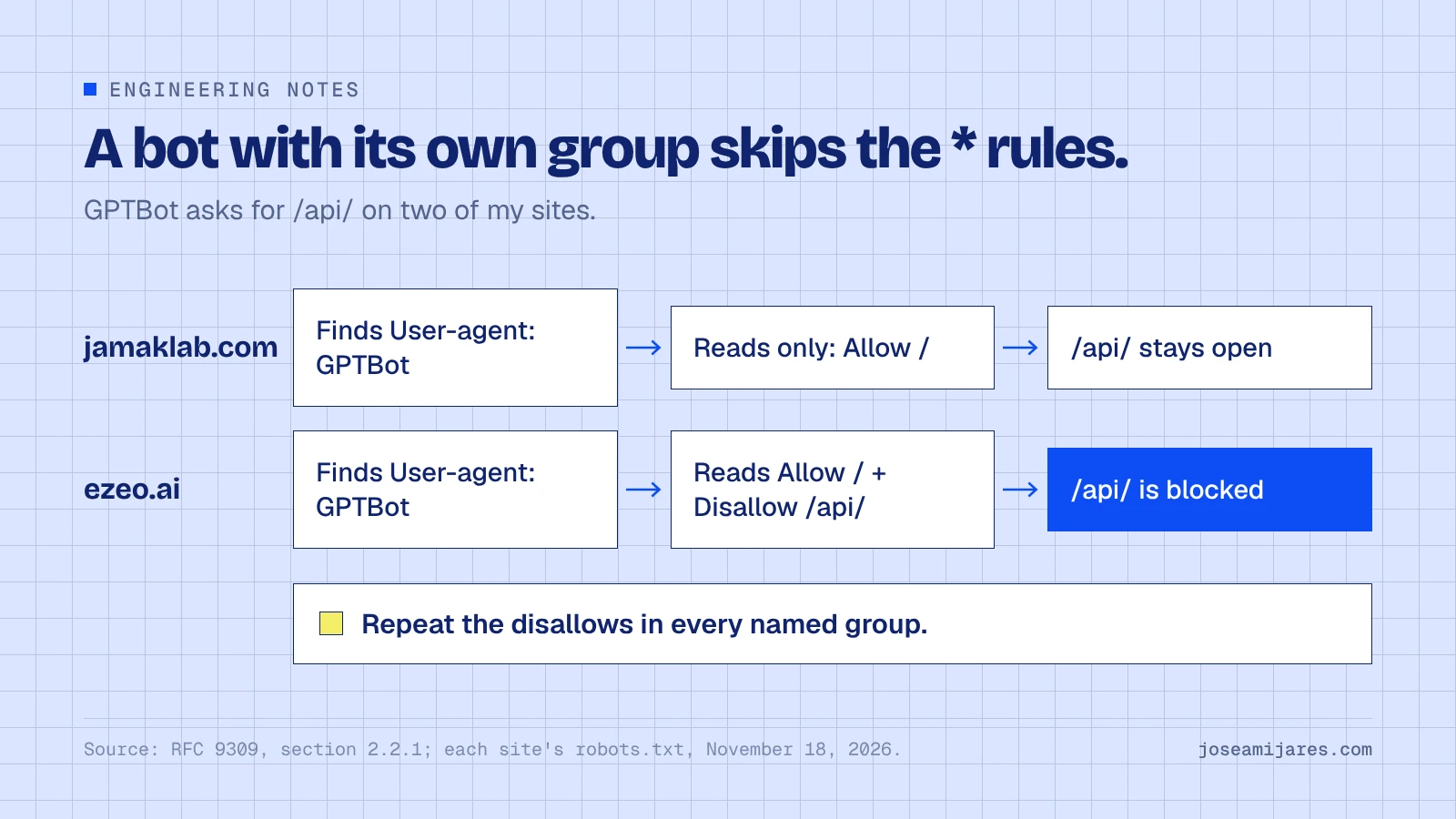
The fix is to repeat the disallows in every named group:
User-agent: GPTBot
Allow: /
Disallow: /api/
Disallow: /admin/
That change is in review for jamaklab.com now. On ezeo.ai, a unit test already reads robots.txt and fails the build when any group is missing a disallow for a private path. That's the version I trust, because the file gets edited by hand and a test catches the drift.
What to do now and what waits for 2027
- Read your robots.txt group by group. For each
User-agentline, list what that bot may fetch. If you rely on*for private paths, every named group needs the same disallows. - Add a test if anything is private. Parse the file in CI and assert that each group disallows each private path.
- Decide on training with
Google-Extendedtoday. It's the control that works now. Name it explicitly, so a future shared token can't change what Google does without you deciding. - Leave the 2027 token alone for now. The draft can still change, and Google hasn't shipped support. Add it once providers say they read it.
- Use the right control for each use.
noindexfor Search, the Search Console setting for AI answers, robots.txt only for fetching.
If your site is a single-page app, an open robots.txt is only half the job. Bots also need HTML they can read without running JavaScript, which is what prerendering a Vite SPA for AI crawlers solves. To see whether any of this changes how AI answers mention you, measure your AI search visibility before and after.
None of these blocks bad actors. A crawler that ignores robots.txt ignores all of it. These controls only work with the bots that follow the rules, and those are the ones your search visibility depends on.
FAQ
Does robots.txt stop AI companies from training on my content?
Not by itself. Robots.txt controls whether a crawler may fetch a URL. A named training token such as Google-Extended tells that one company not to use the content for training. Content fetched before the rule, or by a crawler that ignores it, isn't covered.
Why did my named bot ignore the disallows in the * group?
RFC 9309 says a crawler follows only the most specific group that matches its name. Once a bot has its own group, the * group doesn't apply to it. Repeat every disallow inside each named group.
What is the shared AI-training token Google announced?
It's a robots.txt control from the IETF AI Preferences group that several AI providers plan to read. Google said on October 30, 2026 that it aims to support it in 2027. The draft isn't a standard yet.
Should I block Google-Extended?
Only if you don't want Gemini to train on or ground answers in your pages. Blocking it doesn't remove you from Google Search. This site allows it, because being cited by AI assistants is part of how people find my work.