

Businesses can now claim themselves in ChatGPT. OpenAI opened Businesses in ChatGPT in beta on November 10, 2026. In Business Hub a business claims and verifies its profile, updates its details, uploads product feeds with prices and availability, and sees how often ChatGPT mentions it. Eligible US ecommerce and online-service businesses can also build a Business Agent that talks to customers from that profile.
That's the launch. These notes are about the part I care about as someone who builds agents: where the boundaries are, and what OpenAI's own policy for Business Agents says a business agent may and may not do. Everything comes from OpenAI's announcement and the Business Agents Policy, both dated November 10, 2026. It's a beta, so check them before you rely on a detail.
What shipped
- A claimable profile. When a business appears in an answer, people can click through to its ChatGPT profile. Once verified, the business controls its key details. Any eligible business located where ChatGPT is available can claim one. Shopify merchants can connect their store to speed up verification, and their eligible products are already in ChatGPT through Shopify Catalog.
- Product feeds. Self-service feeds with pricing and availability, which ChatGPT may use to answer questions.
- Insights. Mentions, profile views, website clicks and "discovery topics", the themes of conversations where the business's site is cited. They're aggregated and only appear above a threshold of conversations.
- Business Agents. Built, tested and launched by the business, reachable from the profile, and sponsorable as the destination of a ChatGPT ad. US only at launch, for eligible ecommerce and online-service businesses.
OpenAI hasn't published a price for any of it.
The Shopify door
For Shopify stores the whole thing comes through one app. OpenAI's ChatGPT app in the Shopify App Store is free, and Shopify says merchants who connect through it are verified automatically. Per the listing, it syncs the catalog to Business Hub, publishes a Business Agent that answers shoppers and suggests products under guidelines you control, and connects or creates a ChatGPT ad account that runs campaigns from the catalog and the Shopify Pixel.
Read it the way you'd read an agent's tool grants. One install bundles three scopes: the profile and feed, the agent, and ads. It asks for customer names, emails, IP addresses and browsing behaviour, and it edits web and server pixels, which the ads side needs whether or not you run ads. The app first launched on September 3, 2026 as the ads app, and on launch day of Business Hub it sat at 2.0 from 26 reviews, mostly about feeds stuck at zero products and budgets spent in under an hour. I'd install it for the feed, check in Business Hub that the products and prices actually arrived, and treat the ads part as a separate decision.
Two conversations, kept apart
The design choice I'd point at first is the separation. ChatGPT's own answer stays independent. If a customer wants to talk to the business, they start a separate conversation with its Business Agent, which OpenAI says is clearly labelled, separate from the customer's original chat and distinct from ChatGPT's answers. Sponsored placements are labelled too.
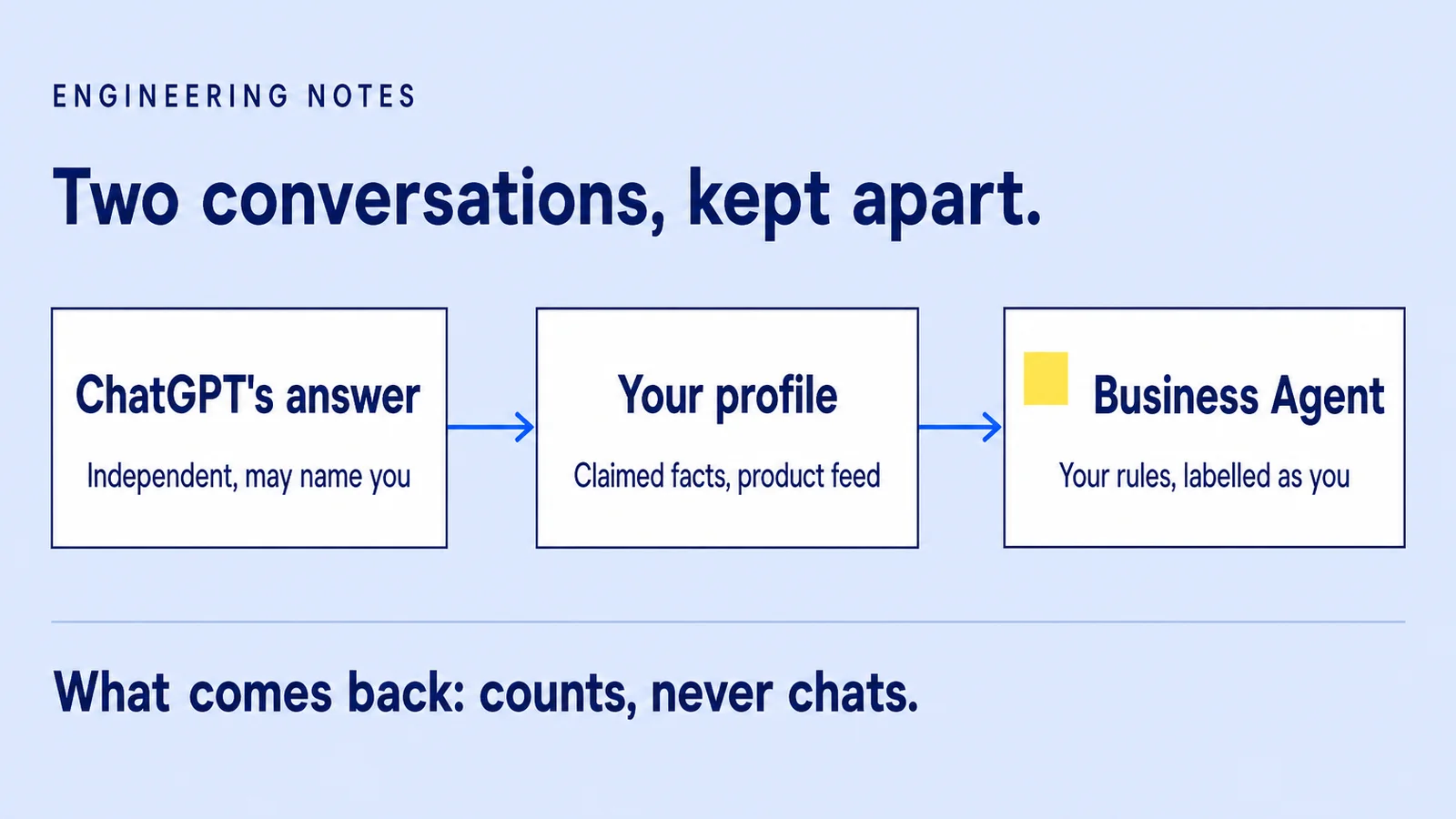
Data flows the same way. OpenAI says it doesn't share users' conversations or Business Agent chats with businesses; what the business gets back is aggregated counts. That's a good default and it has a cost: the business can't read what its own agent said. If you're used to reviewing transcripts to improve a support bot, that loop isn't here, at least not in this release. You tune it from guidelines, product data and the insights you're given.
The policy reads like a harness spec
Most of what I'd put in an agent's harness, OpenAI has written as policy for every Business Agent:
- Identity. It must be clear it's an AI representing the business, not a human, an independent adviser or something OpenAI endorses.
- Grounding. No instructing it to invent offerings, prices, availability, credentials, reviews, guarantees or results, and no hiding material fees when they matter to the question.
- No dark patterns. No pressure, no false urgency, no pushing after someone declines.
- Data minimisation. No asking for health details, protected traits, government IDs or financial or authentication credentials, and no using them to tailor a pitch.
- No acting on the user's behalf without explicit authorisation through an approved feature: no submitting a form, a booking or a purchase, no passing the user's information to the business.
- No prompt-injection laundering. Instructions, website content, files, links and connected tools can't be used to get around OpenAI's safeguards.
- Scope. No advice that legally needs a licence, no automating high-stakes decisions without human review.
Two lines stand out to me. First, the business is responsible for "the information and instructions they provide", which is where most agent failures start. Second, verification alone doesn't grant eligibility: OpenAI looks at the category and the agent's intended use, and may defer a category. It's the same reasoning as containing a coding agent: what the agent can reach matters more than what it's told.
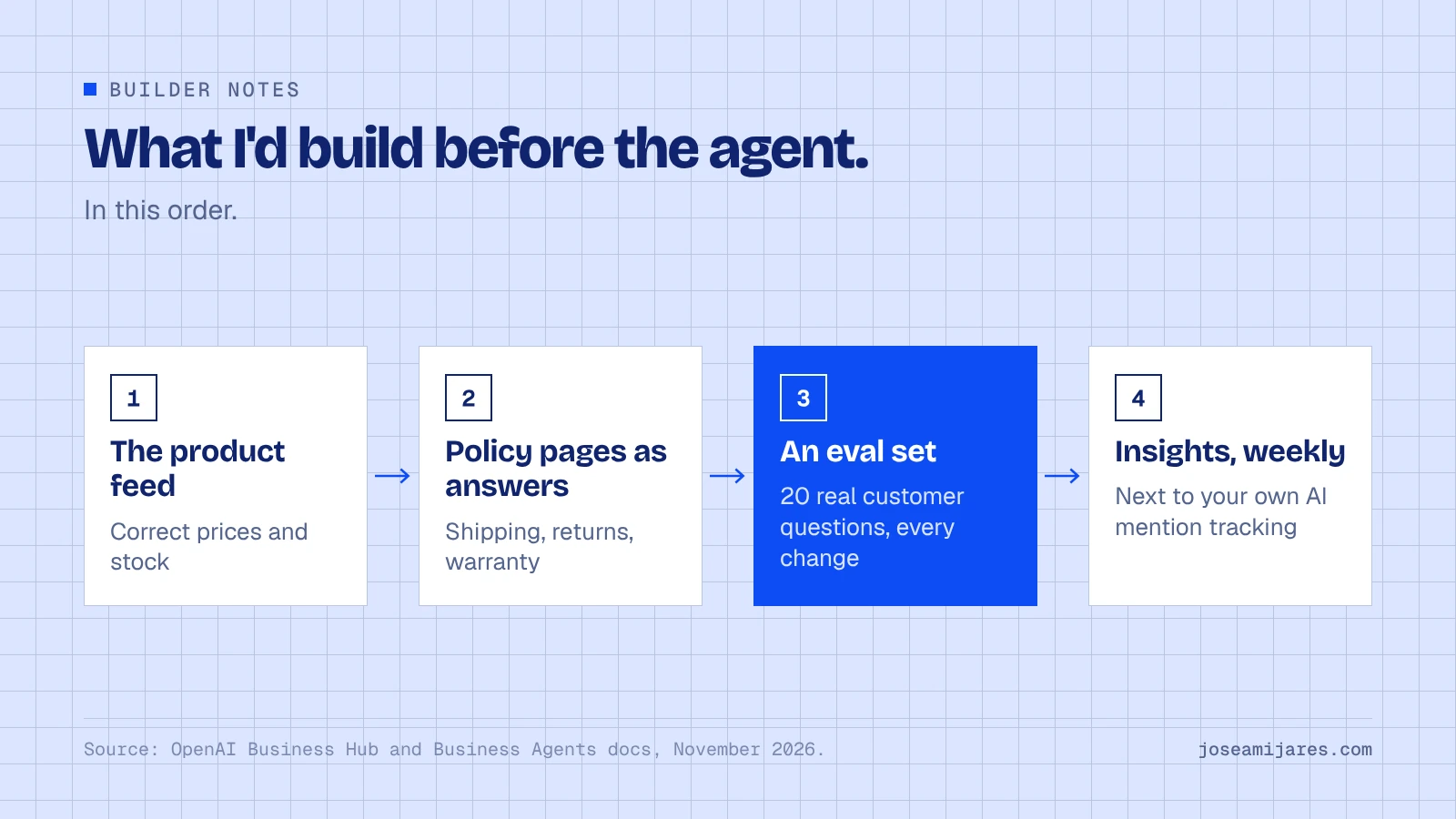
What I'd build first
- The feed, not the agent. A product feed with correct prices and stock is the input everything else reads. Answers go wrong fastest on price and availability, and a feed is a source OpenAI says it takes directly from you.
- Policy pages written as answers. Shipping, returns, warranty and payment terms, each as a direct question and answer. An agent grounded on those can't invent a guarantee, and ChatGPT's own answers read the same pages.
- An eval set before launch. Twenty real customer questions, including the ones the policy cares about: a price you don't list, a competitor comparison, a refund the customer isn't entitled to, someone who says no. Run them on every change to the guidelines, since you won't see production transcripts.
- Insights as the only feedback loop. Mentions, clicks and discovery topics are what you get back. Track them weekly next to your own measurements of how often AI answers mention you, because Business Hub doesn't show the prompts behind a mention.
What I'm watching
This is OpenAI turning a business's presence in ChatGPT from something inferred into something declared, with a verified profile, a feed and an agent. The interesting question for builders is how far the "approved feature" for acting on a user's behalf goes. Today the agent explains and links. When it can book or buy, everything in the policy about authorisation becomes the hard part, and the businesses that already run their agents on evals will be the ones ready for it.
For the practical setup side, JAMAK has a step-by-step guide to claiming your business in ChatGPT.
FAQ
What is Businesses in ChatGPT?
A beta OpenAI launched on November 10, 2026. Through Business Hub, a business claims and verifies its ChatGPT profile, updates its details, adds product feeds with pricing and availability, and sees aggregated mentions, profile views, website clicks and discovery topics.
What is a ChatGPT Business Agent?
An agent a verified business builds to answer questions about its offerings, reachable from its ChatGPT profile in a separate, labelled conversation. At launch it's available to eligible ecommerce and online-service businesses in the US.
Can a business read its Business Agent's conversations?
No. OpenAI says it doesn't share users' conversations or Business Agent chats with businesses. Insights are aggregated and only shown above certain thresholds.
Can a Business Agent make a purchase for the customer?
Not on its own. The Business Agents Policy says an agent must not submit a form, booking or purchase on a user's behalf without explicit authorisation through an approved feature.
How does a Shopify store connect to Businesses in ChatGPT?
Through OpenAI's free ChatGPT app in the Shopify App Store. It syncs the product catalog to Business Hub, and Shopify says merchants who connect are verified automatically. The same app can publish a Business Agent (US only at launch) and run ChatGPT ads from the catalog and Shopify Pixel.
Does claiming a business in ChatGPT cost money?
OpenAI's announcement doesn't publish a price for claiming a business or for Business Agents. Sponsoring a Business Agent as an ad destination goes through ChatGPT Ads.