
Six personal agents now keep working after you close the chat: xAI's Grok Bot, Meta's Muse, Instinct, OpenAI's ChatGPT dots, Anthropic's Claude Duet and Google's Tasks in Gemini. Each one has a real strength, and you can see it in the architecture before you read a single feature list:
- Grok Bot is the best at many people, one agent.
- Muse has the most deliberate guard design: a second agent that has to approve anything going out.
- Instinct has no interface of its own: you text it or call it.
- ChatGPT dots let you write the policy per action: allow, ask, block.
- Claude Duet has the clearest hard limits: things it won't do even if you approve.
- Gemini has the biggest reach, free in six countries, and it can make phone calls.
I read each maker's own page for this on November 22, 2026: Grok Bot 1.0, Muse, Instinct with Plaid's post, dots, Claude Duet and Gemini's release notes. Most of these are betas or previews, so check the page before you build on a detail.
The same six, as systems
| Agent | Where it runs | How you reach it | Where the stop lives | Strongest at |
|---|---|---|---|---|
| Grok Bot 1.0 | xAI's cloud, shared per team | Grok Bot app, Slack, Teams, video calls | Each person's own permissions; asks before sensitive actions | Many people, one agent |
| Muse | Muse Secure VM, one cloud computer per person | Muse app, WhatsApp | A separate Sentinel agent on the same machine | Guard design |
| Instinct | Not documented on its site | Text message or phone call | Asks before next steps (Plaid's examples) | No interface |
| ChatGPT dots | Its own cloud computer | ChatGPT, Slack, Teams, voice | Custom Rules: allow, require approval, block | Policy you write |
| Claude Duet | Its own virtual machine and browser | Duet app, claude.ai | Shows the exact action, then waits; some actions refused | Hard limits |
| Tasks in Gemini | Google's cloud | Gemini app, Google Messages or iMessage, email | One-tap confirmation, device check for payments | Reach, and phone calls |
Pattern 1: the agent gets its own computer
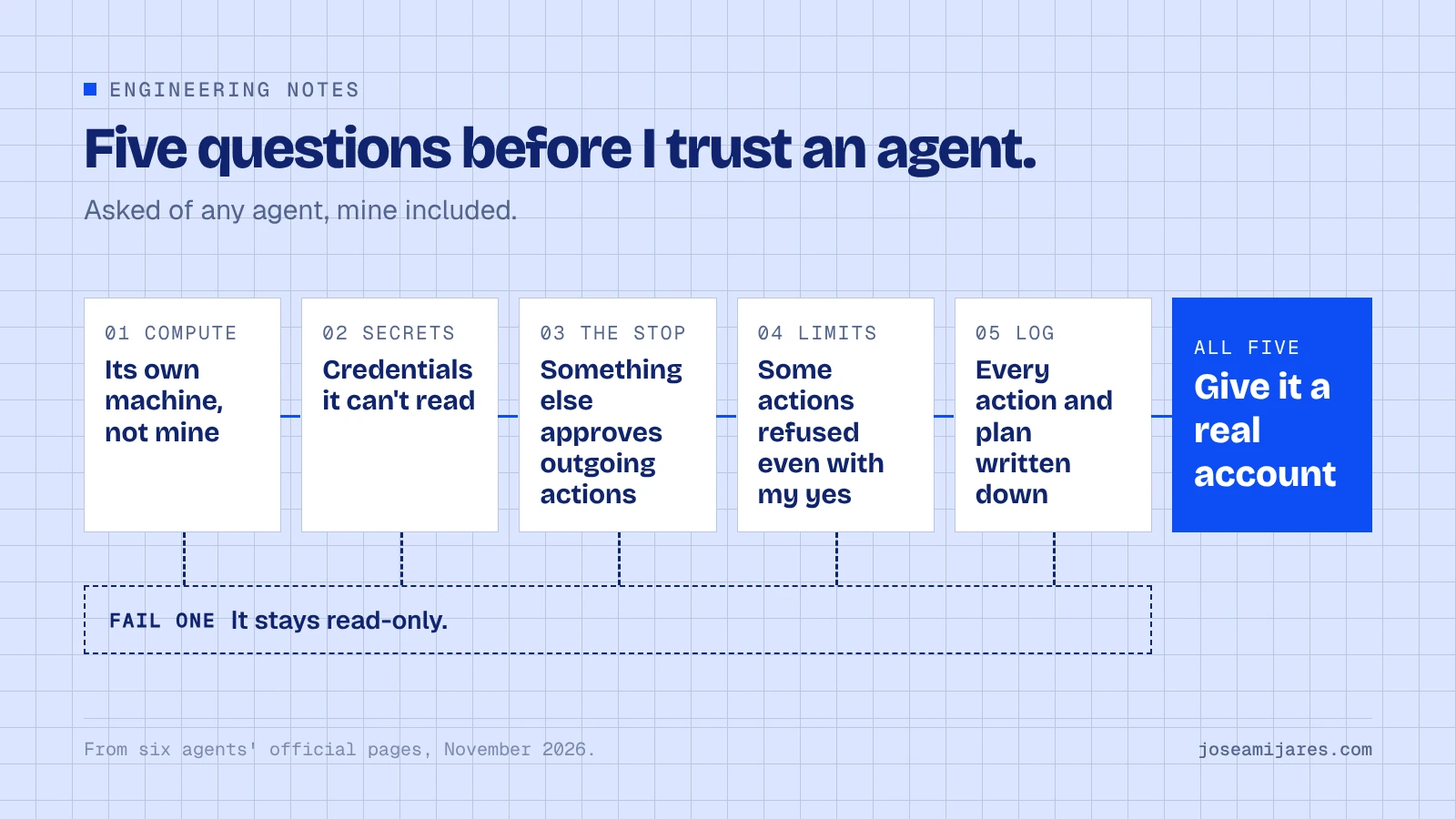
Four of the six say plainly that the agent works on a machine that isn't yours. Muse runs on "Muse Secure VM, a dedicated secure computer with its own browser". A dot "has its own computer". Duet works "in its own virtual machine". Gemini runs tasks in the background and notifies you when they're done.
That separation is the right default. The agent's browser, files and stored sign-ins sit in one box, apart from your laptop. If it goes wrong, the blast radius is that box plus whatever accounts you connected. Instinct describes itself differently: it "can use a phone and computer in the same way that you do." Its site doesn't say where that phone and computer run.
Pattern 2: the channel is the product
Muse works "directly in WhatsApp". Instinct is reached only by text or a call. Gemini added texting through Google Messages or iMessage, and an email address, gemini@google.com, that starts a task when you forward it a thread. Dots are in Slack and Teams, with texting "coming soon".
The lesson for anyone building one: the best agent UI might be a chat app the user already has open. It also means the channel's identity is your auth: a phone number, a WhatsApp account. Treat it like a login, because it is one.
Pattern 3: where the stop lives
Here they differ most, and it's the part worth copying.
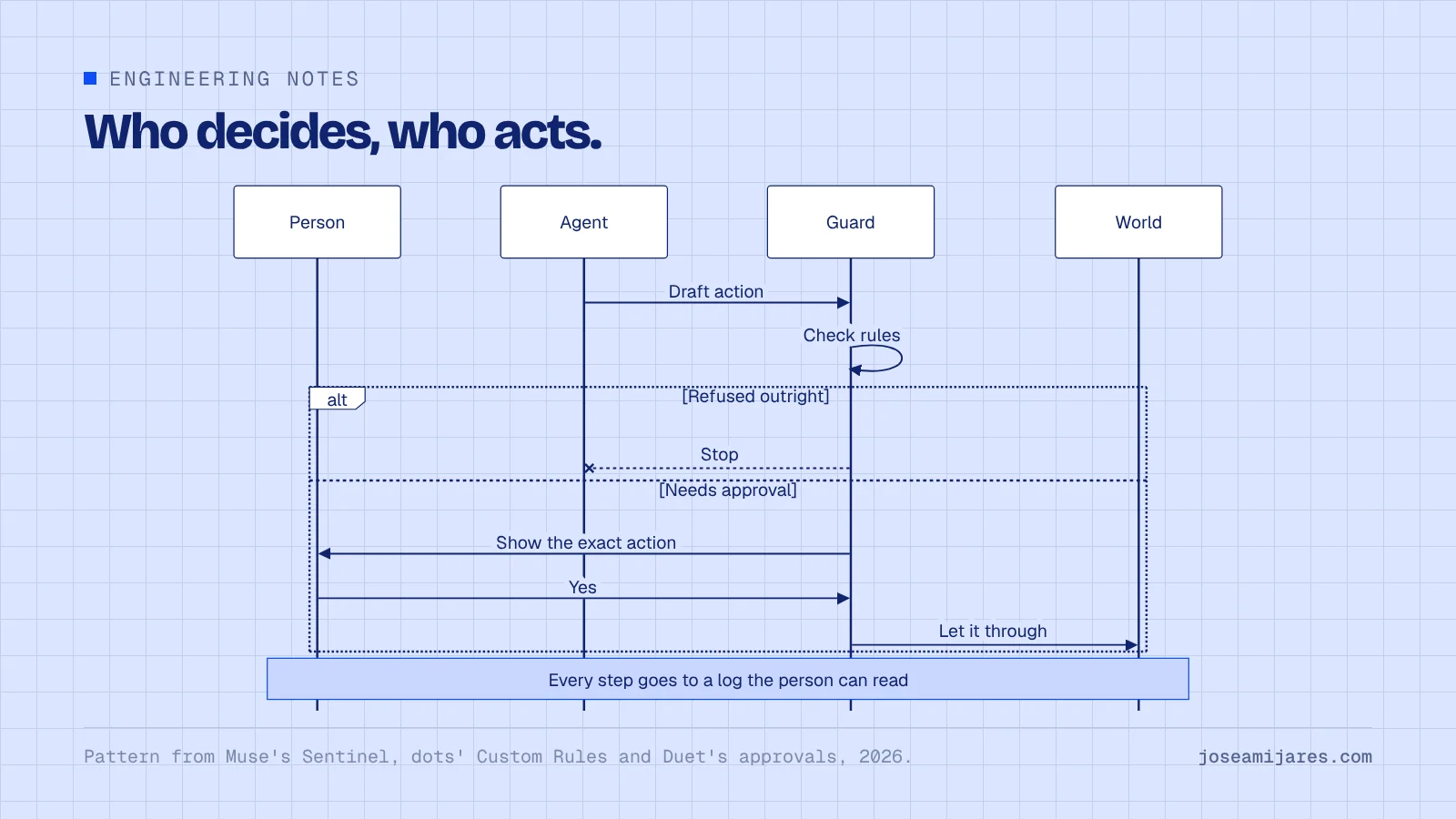
- A guard beside the agent (Muse). A Sentinel agent runs on the same machine, "kept apart from Muse at the system level. Nothing Muse does reaches the internet unless the Sentinel approves it." The thing that decides isn't the thing that acts.
- A policy you write (dots). Custom Rules "allow specific actions, require approval, or block them." When a dot researches on its own initiative, it uses read-only tools, and some tasks, like changing a password, always stay with you.
- Refusals that approval can't unlock (Duet). It shows "exactly what it's about to do" before it sends, pays, signs or deletes. Trading securities and moving money between accounts are off the table even with your yes.
- A one-tap yes (Gemini). Gemini pauses for a 1-tap confirmation before sending or booking, and adds a device check for payments through Google Pay.
- Approvals it learns (Grok Bot). xAI calls it "smarter approvals": the Bot learns when you've already authorized an action and when it needs to ask.

Pattern 4: what the agent can never see
Muse "has no visibility into people's passwords or payment methods": credentials go into secure storage it can use but not read. Duet "never directly sees your passwords or sign-in tokens", and a classifier stops it from sharing the most sensitive data, like card numbers and ID numbers.
Payments follow the same idea. Muse pays through Link by Stripe with a one-time card. Duet uses a Stripe Link virtual card and supports Shop Pay. Gemini checks out with a single-use Google Pay virtual card, so the merchant never gets your real number. Plaid gives Instinct read-only bank connections. The agent can spend or read, but it never holds the real secret.
Pattern 5: one agent, many principals
Grok Bot 1.0 is the multiplayer one. A Team Bot sits in Slack, Teams and video calls, follows threads with several people, and "respects each person's permissions". It also checks "whether information is appropriate to share in a public channel." That's the same problem Anthropic solved for meetings, which I wrote up in Claude Meetings and who a group agent answers to: a shared agent must never become a shared key to everyone's accounts.
The personal version raises the opposite question: whose identity does it post as? I worked through that one in Grok Bot in Slack posts as you, and covered the permissions-first setup for Muse in Meta Muse in Mexico.
What I'd copy into my own agents
- Separate the actor from the approver. Muse's Sentinel is the cleanest version. Even a plain policy check outside the model beats asking the model to police itself.
- Write the policy as data. Dots' allow, ask, block is the right shape: one row per action, readable by the person who owns the risk.
- Keep a short list of refusals. Duet's "no trading, no moving money" list is short and absolute. Short lists get enforced.
- Never hand the model a raw secret. One-time cards and vaulted credentials are cheap now.
- Show the plan, not just the result. Muse shows "a complete audit trail of everything it has done and plans to do." That's the screen I'd build first.
If you're containing coding agents rather than personal ones, the same parts show up in how I contain coding agents.
FAQ
Which personal AI agent is the best?
It depends on the job. As of November 22, 2026, Grok Bot fits a team that shares one agent in Slack or Teams, and Muse fits anyone who wants a free agent in WhatsApp with a separate guard agent. Pick Instinct if you want no app at all, ChatGPT dots for per-action rules, Claude Duet for triage with hard limits, or Tasks in Gemini for free reach and phone calls.
What is the difference between ChatGPT dots and Claude Duet?
Dots are always-on agents with their own cloud computer inside ChatGPT, Slack and Teams, controlled by Custom Rules that allow, require approval for, or block each action. Claude Duet is a separate app in research preview with its own virtual machine; it shows the exact action and waits for approval, and it refuses trading securities and moving money between accounts even with approval.
What is Muse's Sentinel?
A separate agent that runs on the same Muse Secure VM, kept apart from Muse at the system level. According to Meta, nothing Muse does reaches the internet unless the Sentinel approves it, and it asks the person when needed.
Can these agents see my passwords?
Meta says Muse can't see passwords or payment methods, and Anthropic says Duet never directly sees passwords or sign-in tokens. Payments go through one-time or virtual cards (Link by Stripe, Google Pay), so the real card number isn't shared.
Is Gemini's agent free?
Tasks in Gemini became free on November 17, 2026 for users in the US, India, Canada, Australia, Japan and Korea. Gemini Spark, Google's 24/7 personal agent, is for Google AI Ultra subscribers.